
To Buy or Not to Buy: Buying, Renting, or Loaning a Double Bass in Singapore
- mydoublebass

- Jul 4
- 9 min read
One of the most common questions parents and students face when learning the double bass is whether they should buy an instrument.
For many instruments, this question is already difficult. For the double bass, it can feel even more complicated because of its size, cost, maintenance needs, and the limited market in Singapore.
Unlike the violin, flute, clarinet, or guitar, the double bass is not an instrument that most families can casually buy, store, transport, or resell without some planning. It takes up space, it is sensitive to humidity, and a poorly set-up instrument can make learning much harder than it needs to be.
In Singapore, there are generally three forms of access to a double bass:
1. Buying
2. Renting
3. Loaning
Each option has its place, but each also comes with practical considerations. The healthiest choice depends on the student’s goals, level, budget, space, and how long they are likely to continue.
Renting a Double Bass in Singapore
In some countries, renting a double bass is a normal part of the learning journey. Music shops may keep a catalogue of instruments for students to rent, return, upgrade, or exchange as they grow.
In Singapore, the rental market for double basses is much less active.
This is partly due to space. Double basses are large, and businesses need physical storage for instruments that may or may not be rented out consistently. Commercial rental and storage costs in Singapore are high, and keeping several large instruments in good condition is not cheap.
It is also not simply a matter of “having old basses lying around”. A second-hand double bass still needs upkeep. If an instrument comes back with damage, open seams, warped parts, bridge movement, worn strings, buzzing, or setup issues, someone has to assess it, repair it, restring it, and make it playable again.
For a small and unpredictable market, this can become difficult for businesses to sustain.
There is also the question of quality. A rental instrument should still be playable and properly set up. If not, the student may end up fighting the instrument instead of learning the instrument. That creates frustration, bad habits, and sometimes even physical discomfort.
This is why double bass rental in Singapore is limited. It is not because shops are unwilling to help students. It is because the economics are difficult.
At the same time, this is not ideal for students who only need a bass for a short period, such as for a school audition, trial period, DSA preparation, or temporary practice arrangement. For these students, buying may feel too big a commitment, but renting may not be easily available either.
This is where many families start looking for informal solutions.
Loaning a Double Bass
Some teachers or private individuals may offer to loan a double bass to students.
On the surface, this sounds helpful. A student gets access to an instrument, the parent saves money, and lessons can begin quickly.
But loaning is not always as simple as it looks.
A double bass is not a small item that can be passed around casually. It is a large, fragile, and expensive wooden instrument. It can be damaged during transport, affected by humidity, knocked over at home, or returned in a very different condition from when it was loaned out.
If a student stops lessons, who retrieves the bass?
If the instrument is damaged, who pays?
If the bridge has shifted, the strings are worn, or the setup has changed, who decides whether it is normal wear and tear or mishandling?
If the arrangement was made informally, these questions can become awkward very quickly.
This is especially difficult when the loan is tied to a student-teacher relationship. Once money, lessons, trust, instrument use, responsibility, and damage liability are all mixed together, it can become uncomfortable for everyone involved.
Unless the terms are clearly stated from the beginning, loaning an instrument can easily strain relationships. What was intended as a helpful gesture may later become a source of misunderstanding.
Loaning a Better Instrument for Exams or Recordings
Another arrangement sometimes seen is when a student buys a cheaper instrument, while the teacher loans a better or more expensive bass later for exams, auditions, or recordings.
This may sound practical, but it can also create problems.
A student should ideally learn, practise, and perform on an instrument that is suitable for their current level and slightly beyond it. The instrument does not need to be extremely expensive, but it should be playable, stable, and responsive enough to support the student’s development.
If the student is not yet able to hear, feel, or understand the difference between a $2,000 bass and a $10,000 bass, then it may not make sense to over-invest too early. A more modest but well-set-up instrument may be enough at that stage.
However, relying on a borrowed expensive bass only for the final stage of an exam or recording is also not ideal.
A student needs time to adjust to an instrument. Every bass feels different. The string length, neck shape, response, resonance, wolf notes, action height, bow response, and body size can all affect playing.
If a student is going to use a different bass for an important recording or examination, they may need at least two to four weeks to get used to it properly.
This creates another issue: what happens if the expensive instrument is damaged during that loan period?
Even careful students can make mistakes. Accidents happen. A bass can be knocked, scratched, exposed to humidity changes, or damaged during transport.
When the instrument belongs to the teacher, this can become very uncomfortable. The student may feel guilty. The parent may feel pressured. The teacher may feel stuck. It is not a healthy situation unless everything has been clearly agreed upon beforehand.
When Loaning May Make Sense
There are situations where loaning an instrument can be appropriate.
For example, a student may have genuine financial difficulty but show strong potential, commitment, and responsibility. In such cases, a teacher, school, or community may want to help the student continue learning.
That kind of support can be meaningful.
However, even then, loaning should not be seen as a permanent solution. The long-term goal should still be for the student to eventually have access to an instrument of their own, whether through saving, family support, school support, sponsorship, or a planned purchase later on.
Loaning can be a bridge.
It should not become the entire road.
How Long-Term Loaning Affects the Ecosystem
There is also a wider issue that is not always discussed.
When too many students rely on borrowed instruments instead of buying suitable instruments when they are ready, it affects the entire double bass ecosystem.
Dealers and shops respond to demand. If fewer students buy mid-range or higher-quality instruments, shops become less willing to bring them in. After all, each double bass takes up space, costs money to import, and may sit unsold for a long time.
Over time, this reduces the variety of instruments available locally.
This is already something advancing students may experience. A student may finally be ready to upgrade, have the budget to buy a better bass, and still find that there are very few instruments available to try.
Instead of walking into a shop and comparing several suitable basses, they may only see limited stock, sold-out listings, or instruments that need to be ordered in advance.
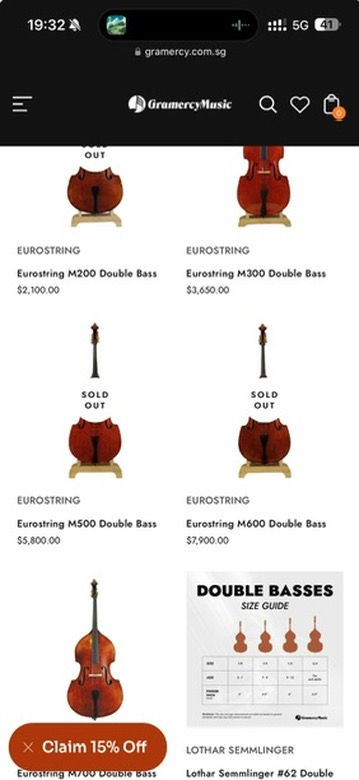

Ordering an instrument without trying it is not ideal. Double basses are highly individual. Two instruments of the same model can still feel and sound different. For advancing students, being able to test an instrument matters.
A healthy ecosystem needs students, teachers, parents, dealers, repairers, and shops to work together. When instruments are bought, maintained, repaired, resold, upgraded, and circulated properly, everyone benefits.
When long-term informal loaning becomes too common, it may seem helpful in the short term, but it can weaken the market in the long run.
Buying a Double Bass
Buying a double bass is a big decision, but for many committed students, it eventually becomes the most stable option.
Before buying, the first question should not be “Which bass should I buy?”
The first question should be:
Why are we buying one?
The answer may differ from student to student.
Some students need a bass because the school instrument is not available for home practice. Some need one because they are preparing for DSA, auditions, exams, or ensemble playing. Some are learning outside of school and need regular access to practise. Some have outgrown their current instrument. Some are ready to take the instrument more seriously.
The clearer the goal, the easier it is to decide how much to spend.
Budget: Spend Responsibly
A double bass is not cheap. But that does not mean every student needs to buy the most expensive instrument immediately.
The budget should be livable.
It is not healthy to spend thousands of dollars on a double bass and then feel financially stressed for the next few months. The instrument should support the student’s learning, not become a source of family anxiety.
As a general principle, buy the best instrument you can reasonably afford, but do not over-stretch.
If the student is still a beginner and cannot yet tell the difference between a $2,000 bass and a $10,000 bass, it may be wiser not to over-invest too early. At that stage, a decently made and well-set-up bass may be more useful than an expensive instrument that the student is not ready to appreciate.
For intermediate or advancing students, however, a better instrument can make a real difference. A responsive bass can help with sound production, shifting, bow control, projection, and musical confidence.
The key is not simply price.
The key is suitability.
Could Hire-Purchase Be an Option?
For families who are serious about buying a double bass, but may find it difficult to pay the full amount upfront, another possible option is to speak with the shop about whether a hire-purchase or instalment arrangement is available.
This is not something every shop will offer, and it should not be assumed. Double basses are expensive to import, store, maintain, and hold as stock, so shops may not always be able to provide flexible payment terms.
However, if the student is committed and the family has a clear plan, it may be worth asking politely.
A structured arrangement can sometimes be healthier than relying on an indefinite informal loan. The terms can be made clearer from the beginning: how much is paid upfront, how long the payment period is, who is responsible for damage, what happens if the student stops, and when ownership is officially transferred.
This protects both the family and the shop.
Of course, families should still be careful not to over-stretch financially. Instalments may make a purchase feel more manageable, but the total cost is still real. The instrument should still fit the student’s level, goals, and budget.
In that sense, hire-purchase should not be seen as a way to buy beyond one’s means. It is simply one possible bridge between short-term access and proper long-term ownership.
Setup Matters
A decent instrument with poor setup can feel terrible.
A modest instrument with good setup can often serve a student much better than expected.
When buying a double bass, setup should not be treated as an afterthought. The bridge height, string height, fingerboard condition, soundpost, strings, tailpiece, and general playability all affect the learning experience.
For younger students especially, a badly set-up bass can make basic playing unnecessarily difficult. They may press too hard, tense up, struggle to produce sound, or assume that they are the problem when the instrument is actually working against them.
A good setup does not magically make a student practise. But it removes unnecessary obstacles.
That matters.
Space and Humidity
Before buying a double bass, families should also consider space.
A double bass needs a safe place to stand or lie down. It should not be placed where people may knock into it, where young children may pull at it, or where it is exposed to direct sunlight, strong air-conditioning, or large humidity changes.
Singapore’s humidity is another concern. Wooden instruments can be affected by prolonged humidity exposure. Open seams, buzzing, mould, swelling, unstable tuning, and setup changes can happen when the instrument is not cared for properly.
Ideally, the bass should be kept in a room where humidity can be reasonably managed. This does not mean every family must create a perfect museum-level storage space, but the instrument should not be treated like furniture that can survive anything.
A double bass is a living wooden instrument. It needs some care.
So, Should You Buy, Rent, or Loan?
There is no single answer for every student.
Renting can be useful, but double bass rental options in Singapore are limited.
Loaning can help in special circumstances, but it should be handled carefully and not treated as a casual long-term solution.
Buying is usually the most stable option for committed students, but the purchase should be planned properly.
For most families, the decision should come down to a few practical questions:
Is the student likely to continue long enough to justify owning an instrument?
Does the student need regular home practice to meet their goals?
Is the current school instrument enough?
Is the budget comfortable?
Is there enough space at home?
Can the family manage basic care and humidity concerns?
Is the instrument suitable for the student’s current level and near-future growth?
A double bass does not need to be the most expensive instrument in the shop to be useful. But it does need to be playable, suitable, and properly set up.
The goal is not to buy for the sake of buying.
The goal is to give the student a fair chance to learn properly.
Final Thoughts
In a small market like Singapore, every decision affects more than just one student.
When students buy suitable instruments, shops have more reason to bring in better stock. When better stock is available, advancing students have more choices. When instruments circulate through proper purchase, resale, repair, and upgrading, the ecosystem becomes healthier.
When too many arrangements depend on informal long-term loaning, the short-term convenience may come at a long-term cost.
For a beginner, the right answer may be to wait.
For a committed student, the right answer may be to buy.
For a student with financial difficulty, a temporary loan may be a kind and practical bridge.
But whatever the arrangement, it should be clear, responsible, and sustainable.
A double bass is not just an object to possess. It is part of a student’s learning environment.
And when chosen well, cared for properly, and matched to the student’s needs, it can make the journey much more enjoyable.


Comments